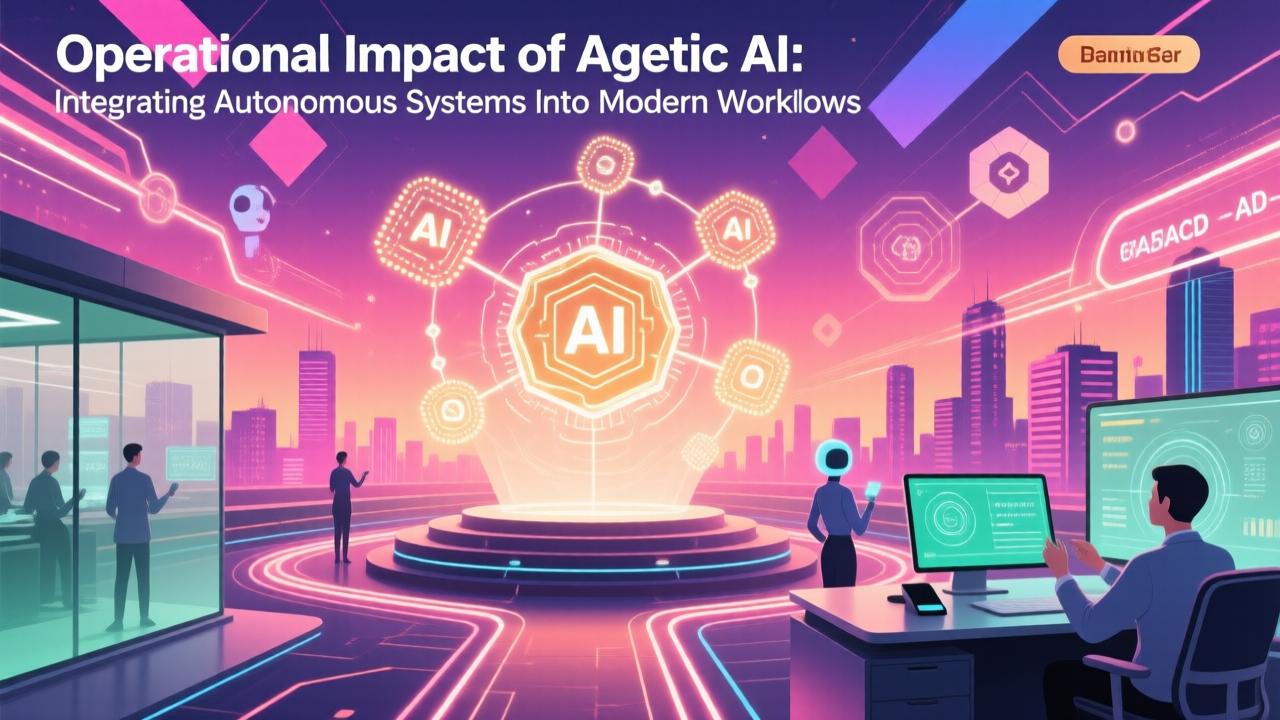

The workplace of tomorrow is already here. Autonomous systems, once confined to science fiction, are now redefining operational efficiency, decision-making, and human-machine collaboration. Agentic AI – systems capable of self-directed action, reasoning, and environmental interaction – is no longer a distant promise but a present-day imperative. From optimizing supply chains to revolutionizing healthcare diagnostics, the operational impact of agentic AI is profound. This article deciphers how these systems are transforming workflows, the frameworks enabling their integration, and the strategic considerations for mid-level managers navigating this shift.
Executive Summary
- Shift from isolated models to agentic systems: Modern AI agents integrate databases, external tools, and autonomous decision-making, moving beyond single-model solutions.
- Reinforcement learning and LLMs as catalysts: The agentic era (2010s–present) was driven by large language models (LLMs) and reinforcement learning, enabling general-purpose reasoning and autonomous action.
- Ethical and governance frameworks: New protocols like the Model Context Protocol (MCP) and Agent Communication Protocol (ACP) address risks in agentic AI deployment.
- Multi-agent collaboration: Frameworks like crewAI and AutoGen demonstrate how distributed systems solve complex tasks through agent coordination.
- Historical parallels: Early concepts in cybernetics and neural networks laid the groundwork for today’s agentic architectures, showing continuity in AI research.
The Agentic Era: From Isolated Models to Autonomous Systems
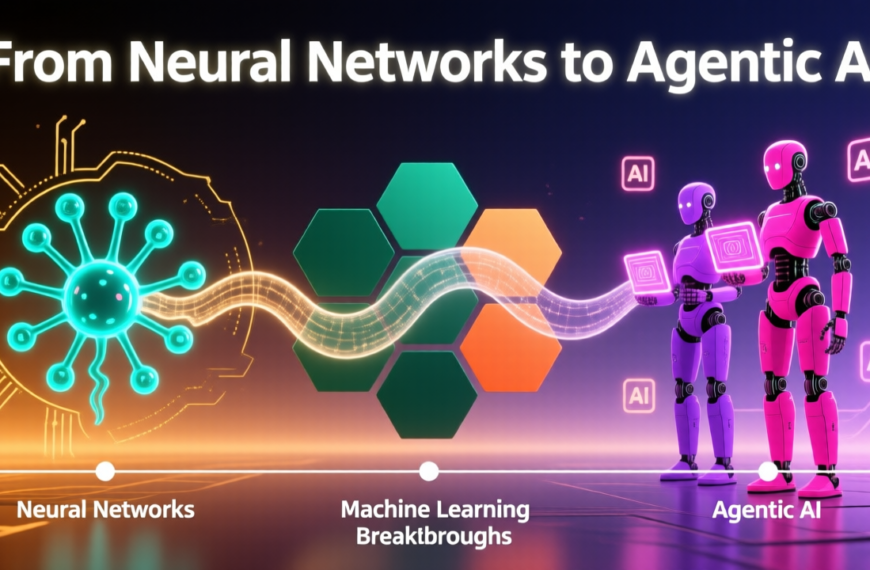
The evolution of AI has followed a clear trajectory: from rule-based systems to statistical models, and now to autonomous agents capable of self-directed action. This shift is not merely technological – it is operational. Agentic AI systems, unlike traditional generative AI, do not simply produce content; they act. They perceive their environment, reason about goals, and execute plans, often in real time.
From Monolithic Models to Compound Systems
Early AI systems were monolithic, relying on predefined rules or statistical patterns. Today’s agentic systems are compound, integrating databases, external APIs, and even physical robots. For example, the PR2 robot (early 2010s) combined ROS (Robot Operating System) with deep learning to perform multi-step tasks like object manipulation and navigation. This integration of perception, reasoning, and action is the hallmark of agentic AI.
Case Study: The PR2 Robot
The PR2 robot, developed by Willow Garage, became a standard in autonomous manipulation. By pairing ROS with advanced algorithms, it could plan, execute, and adapt to tasks in dynamic environments. This laid the groundwork for modern agentic systems, where LLMs like GPT-4o (2023–2024) now process visual, auditory, and textual data to make decisions in real time.
Reinforcement Learning and LLMs: The Catalysts of Autonomy
The rise of agentic AI is inseparable from two breakthroughs: reinforcement learning (RL) and large language models (LLMs). RL, which emerged in the 2010s, enabled systems to learn from trial and error, while LLMs provided the reasoning and language capabilities needed for complex tasks.
Reinforcement Learning: Learning by Doing
Reinforcement learning (RL) allows agents to optimize actions through feedback loops. For instance, AlphaGo’s integration of deep neural networks with Monte Carlo Tree Search (2010s) demonstrated how RL could solve strategic problems. Today, RLHF (Reinforcement Learning from Human Feedback) ensures AI aligns with human values, a critical step in deploying agentic systems in sensitive domains like healthcare.
Case Study: Meta AI’s Toolformer
Meta AI’s Toolformer (2023) marked a turning point. By enabling LLMs to autonomously select and use external tools, it bridged the gap between language models and actionable systems. This capability is now foundational for frameworks like AutoGen and crewAI, which orchestrate multi-agent workflows for tasks like retail shelf optimization.
Ethical and Governance Frameworks: Navigating the Risks
As agentic AI becomes more autonomous, ethical and governance frameworks are essential. The Model Context Protocol (MCP) and Agent Communication Protocol (ACP), introduced in 2024, standardize how agents interact with external systems and each other. These protocols ensure transparency, security, and human-in-the-loop oversight.
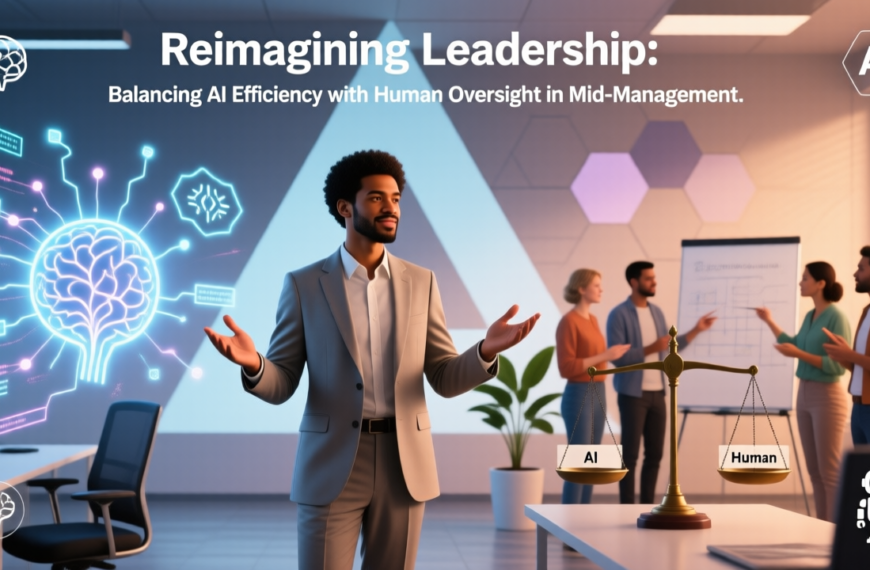
Human-in-the-Loop: Balancing Autonomy and Control
Agentic systems must operate within ethical boundaries. For example, in healthcare, an AI agent diagnosing infections must be auditable and explainable. Frameworks like ReAct (Reason-Act) provide structured loops for agents to think, act, observe, and repeat, ensuring decisions are traceable and reversible.
Practical Application: Governance in Action
Consider a supply chain managed by agentic AI. The system might autonomously reroute shipments based on real-time data, but it must also log decisions and allow human intervention if anomalies arise. This balance is achieved through protocols like MCP, which define how agents access and update external data sources.
Multi-Agent Collaboration: The Power of Distributed Intelligence
Agentic AI is not limited to single agents. Multi-agent systems, such as crewAI and AutoGen, enable collaboration across specialized agents. This distributed intelligence is critical for solving complex problems that no single agent could handle alone.
Frameworks for Collaboration
Frameworks like AutoGen use a “contract net protocol” to assign tasks to agents based on their capabilities. For instance, in a retail setting, one agent might analyze sales data, another optimize pricing, and a third manage inventory. This division of labor mirrors human teamwork but at machine speed.
Case Study: crewAI in Retail
crewAI has been deployed to optimize retail shelf layouts. By analyzing customer behavior data, the system autonomously adjusts product placements, reducing manual labor and increasing sales. This example illustrates how multi-agent systems can transform operational workflows.
Historical Parallels: From Cybernetics to Modern Agentic Systems
The roots of agentic AI stretch back to the 1940s. Warren McCulloch and Walter Pitts’ 1943 work on neural networks laid the foundation for computational models of thought. Alan Turing’s 1950 Turing Test introduced the idea of machines mimicking human intelligence, while the 1955 coining of “artificial intelligence” marked the field’s formal birth.
Continuity in Innovation
These early concepts are not obsolete – they are the bedrock of today’s agentic systems. For example, the belief–desire–intention (BDI) model, a framework for agent behavior, echoes cybernetic principles of self-regulation. Understanding this continuity helps managers contextualize current trends within a broader historical arc.
Strategic Integration: How to Apply Agentic AI in Your Workflow
For mid-level managers, the challenge is not just understanding agentic AI but integrating it effectively. Here’s how to begin:
Step 1: Identify Operational Pain Points
Start by mapping tasks that are repetitive, data-intensive, or require real-time decision-making. These are prime candidates for agentic AI. For example, customer service queries could be handled by an agent that autonomously routes issues to the right department.
Step 2: Choose the Right Framework
Frameworks like LangChain and AutoGen provide templates for building agentic workflows. LangChain is ideal for integrating LLMs with external tools, while AutoGen excels in multi-agent collaboration. Select based on your team’s technical expertise and operational needs.
Step 3: Implement Governance Protocols
Adopt protocols like MCP and ACP to ensure agents operate within ethical and technical boundaries. Regular audits and human-in-the-loop mechanisms are critical to maintaining trust and compliance.
Frequently Asked Questions
How can I start integrating agentic AI into my team’s workflow?
Begin by identifying repetitive or data-heavy tasks. Use frameworks like LangChain or AutoGen to build agent workflows, and ensure governance protocols like MCP are in place to manage risks.
What are the main risks of deploying agentic AI?
Risks include loss of control, ethical missteps, and operational errors. Mitigate these with human-in-the-loop oversight, regular audits, and adherence to protocols like ACP and MCP.
How do I ensure agentic AI aligns with company values?
Implement ethical frameworks, such as RLHF, to train agents on company-specific values. Regularly review agent decisions and maintain transparency in their operations.
Can agentic AI replace human workers?
Agentic AI is designed to augment, not replace, human workers. It handles repetitive tasks, freeing employees to focus on strategic and creative work. The goal is collaboration, not substitution.
What tools are available for managing agentic AI systems?
Tools like AutoGen, crewAI, and LangChain provide the infrastructure for building and managing agentic workflows. These frameworks support multi-agent collaboration, external tool integration, and governance protocols.
Reflection: The Future of Work is Agentic
The operational impact of agentic AI is not just about efficiency – it’s about reimagining what is possible. From autonomous robots to multi-agent systems, the future of work is defined by collaboration between humans and machines. For mid-level managers, the challenge is to embrace this shift strategically, ensuring that agentic AI enhances, rather than disrupts, organizational goals. As the agentic era unfolds, those who adapt will lead the next wave of innovation.


 By
By
 By
By