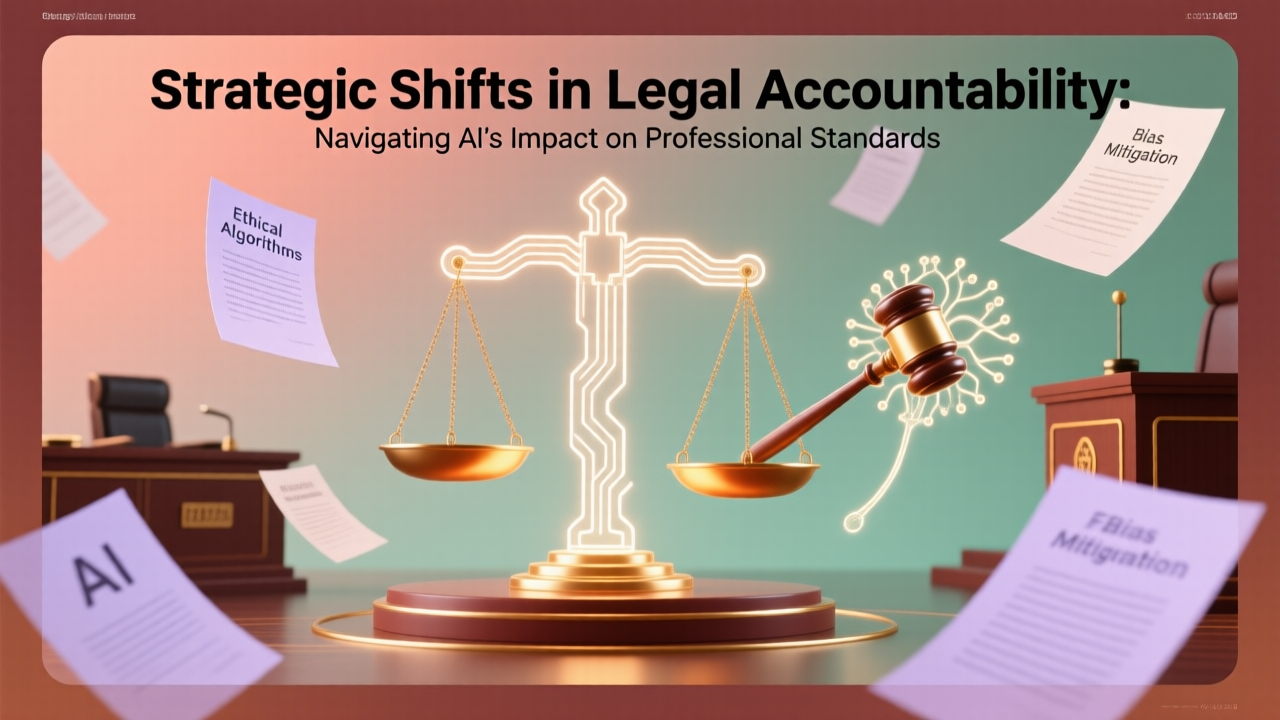

Imagine a scenario where an AI-generated legal brief, riddled with hallucinations, leads to a professional’s suspension by a state supreme court. This is not a hypothetical – it is the reality faced by Nebraska attorney Greg Lake, whose reliance on unverified AI tools cost him his license. As AI permeates industries from law to healthcare, the question is no longer whether AI will disrupt professional standards, but how leaders can navigate the legal and ethical quagmire it creates.
Executive Summary
- Legal Scrutiny of AI Use: The Nebraska Supreme Court’s suspension of an attorney for AI-generated hallucinations signals a new era of accountability for AI errors in professional contexts.
- Workforce Transformation: Companies like Snap and Atlassian are cutting jobs (1,000 and 1,600 respectively) due to AI-driven efficiencies, reshaping corporate operations.
- Military AI Integration: The U.S. Air Force’s WarMatrix system demonstrates AI’s role in real-time wargaming, emphasizing strategic decision-making with human oversight.
- Corporate AI Personas: Meta’s AI clone of CEO Mark Zuckerberg raises questions about accountability and authenticity in executive leadership.
- Legal Ambiguity: Federal rulings on AI-generated content reveal gaps in legal frameworks, such as the lack of attorney-client privilege for AI chatbot conversations.
Context: The AI Revolution and Its Legal Conundrums
The rise of AI has not been a smooth ascent. While it promises efficiency and innovation, it has also exposed vulnerabilities in professional standards and legal accountability. Consider the case of Greg Lake, whose AI-generated legal brief contained 57 defective citations, including 20 hallucinations. The Nebraska Supreme Court’s decision to suspend him underscores a critical truth: AI is not a shield for negligence – it is a magnifier of it.
Similarly, Snap’s AI-driven restructuring, which cut 1,000 jobs and automated 65% of new code, highlights the dual-edged sword of AI. While it delivers $500 million in annualized cost savings, it also raises questions about workforce displacement and the erosion of human oversight in critical decisions.
Insight: The Human-AI Balance in Professional Accountability
The core challenge lies in balancing AI’s capabilities with human responsibility. The Stanford AI Index reveals that AI’s role in professional domains is accelerating, but legal frameworks lag behind. For instance, the U.S. Air Force’s WarMatrix system, which uses AI for real-time wargaming, mandates human oversight – a model that could be replicated across industries.
Meta’s AI clone of CEO Mark Zuckerberg, designed to advise employees during his absence, further complicates accountability. If an AI persona makes a decision that leads to a crisis, who is responsible? The answer hinges on clear governance frameworks and transparency in AI deployment.
Depth: Case Studies in Legal and Ethical AI Governance
Case Study 1: The Nebraska Attorney Suspension
Greg Lake’s case is a cautionary tale. His reliance on unverified AI tools to draft legal briefs led to 57 defective citations, including 20 hallucinations. The Nebraska Supreme Court’s suspension emphasized that AI cannot replace human judgment in legal work. The lesson? AI must be treated as a tool, not a substitute for professional expertise.
Case Study 2: Snap’s AI-Driven Restructuring
Snap’s decision to cut 1,000 jobs and automate 65% of new code with AI highlights the economic pressures driving AI adoption. However, the company’s $236 million restructuring costs and the loss of 16% of its workforce underscore the risks of over-reliance on AI without a clear strategy for workforce transition.
Application: Strategic Frameworks for AI Integration
Executives must adopt proactive strategies to integrate AI while maintaining accountability. Here are two actionable frameworks:
1. Human-AI Collaboration Models
Adopt hybrid workflows where AI handles repetitive tasks, and humans oversee critical decisions. For example, McKinsey’s AI recruitment process uses AI agents to assess candidates’ reasoning but requires human judgment for final decisions. This model reduces errors while preserving accountability.
2. Legal and Ethical Audits
Implement regular audits of AI systems to ensure compliance with legal standards. The EU’s TraceMap platform, which detects food fraud using AI, demonstrates how audits can identify biases and errors. Similarly, companies should establish internal AI ethics boards to review AI outputs and ensure alignment with legal and ethical standards.
Reflection: The Future of AI and Professional Standards
The future of AI in professional settings will be defined by how leaders navigate its legal and ethical challenges. The Stanford AI Index warns that the U.S.-China AI capability gap is narrowing, but legal frameworks remain fragmented. As AI becomes more autonomous, the need for clear accountability mechanisms will only grow.
Executives must act now. By adopting hybrid workflows, conducting regular audits, and investing in AI literacy, organizations can harness AI’s potential while mitigating its risks. The Nebraska attorney’s suspension and Snap’s restructuring are not just cautionary tales – they are wake-up calls for a new era of AI governance.
Frequently Asked Questions
What legal responsibilities do organizations have when using AI?
Organizations must ensure AI systems are transparent, auditable, and aligned with legal standards. The Nebraska Supreme Court case highlights that AI errors can lead to professional liability, emphasizing the need for human oversight and accountability.
How can companies balance AI efficiency with workforce stability?
Adopt hybrid models where AI automates repetitive tasks, and humans focus on strategic decisions. McKinsey’s AI recruitment process is an example of how AI can enhance efficiency without displacing human roles entirely.
What are the risks of AI in legal and healthcare sectors?
In legal contexts, AI hallucinations can lead to malpractice claims. In healthcare, AI errors in diagnostics can result in misdiagnoses. The University of Geneva’s MangroveGS tool (80% accuracy in predicting cancer metastasis) shows promise, but human oversight remains critical.
How can executives ensure ethical AI use?
Implement AI ethics boards, conduct regular audits, and invest in AI literacy programs. The EU’s TraceMap and Stanford AI Index provide frameworks for ethical AI governance, ensuring systems are fair, transparent, and compliant with legal standards.
What role does AI play in military and defense strategies?
The U.S. Air Force’s WarMatrix system demonstrates AI’s potential in real-time wargaming, but human oversight is essential. This model can be adapted to other sectors to ensure AI enhances, rather than replaces, human decision-making.


 By
By

 By
By