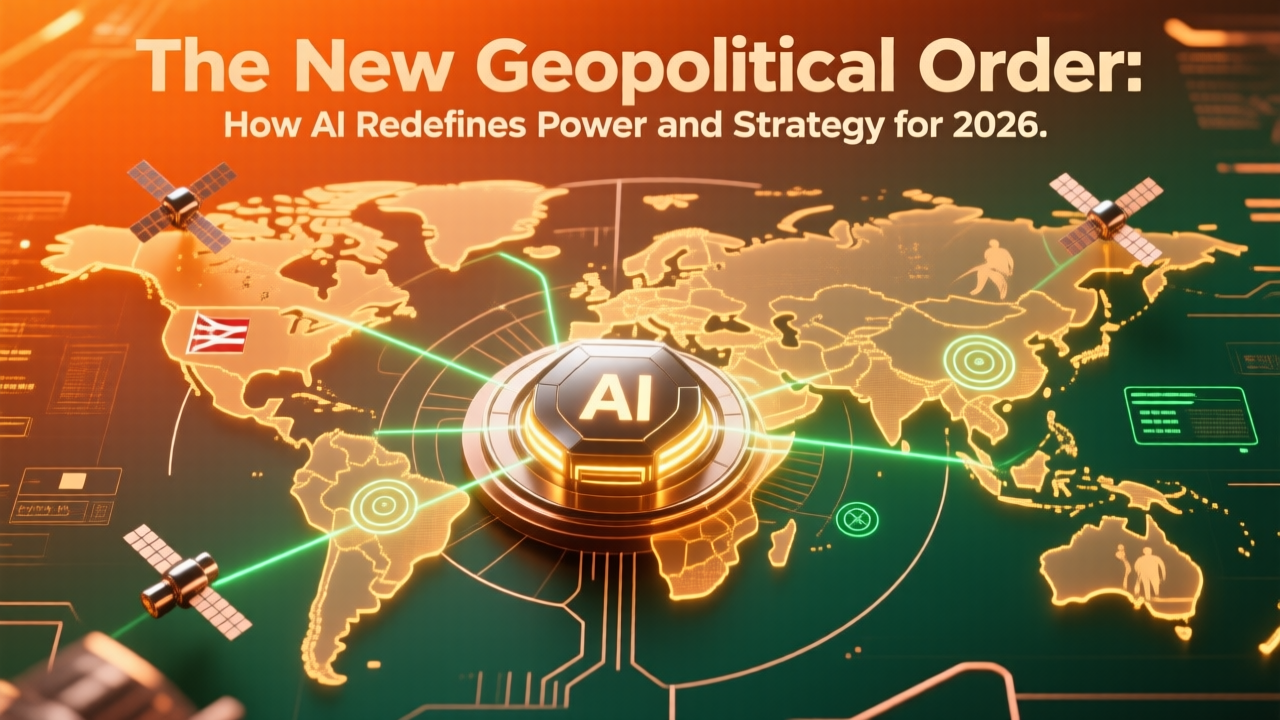

Executive Summary: Beyond the Algorithm
-
The Predictability Paradox: AI grants unprecedented foresight, but the 2026 order will be shaped less by algorithmic accuracy than by the human judgment to know when to override it.
-
Economic Scalpels Not Sledgehammers: Economic coercion has moved from blanket sanctions to transaction level chokepoint manipulation driven by AI, hitting shadow fleets and front companies in seconds.
-
The Eleven Minute Warning: Real world systems now detect sanctions busting anomalies faster than a human can read a cable, compressing the decision loop to minutes.
-
Automated Perception Warfare: Narrative manipulation powered by AI now sways public legitimacy more effectively than artillery because entire information environments are tailored to micro audiences.
-
Autonomous Mercenaries and Human Consequences: Autonomous logistics and drones are rewriting the business of force, but accountability remains stubbornly human.
-
The Coming Asymmetry Trap: Overreliance on models trained on Western conflict data risks catastrophic blindness to non state, non Western strategies.
Introduction: Eleven Minutes
On a humid March morning in 2025, an AI monitoring global maritime insurance patterns detected an anomaly. A single cargo vessel, overinsured by a factor of seven for a routine Gulf route, had filed a new policy routing it near the Strait of Hormuz with an uncharacteristically indirect final destination. Within six minutes, the system had cross referenced beneficial ownership networks, identifying a shell company linked to a sanctioned Iranian petrochemical conglomerate. Within eleven minutes, 240 million dollars in pending wire transfers were frozen across three jurisdictions without a single human analyst in the loop. The target never learned it had been hit until a bank called days later.
This is not cyberpunk fiction. It is the new operating reality of geopolitical power, and it compresses the decision loop from weeks to minutes. Yet the most unsettling part of the story is what happened next. A human override committee, terrified of market blowback, released the freeze 48 hours later, just as a secondary AI flagged the same vessel loading dual use equipment. The real battle of 2026 is not state versus state AI supremacy. It is the volatile gap between what the machine can foresee and what human institutions dare to act upon. This dynamic defines the Predictability Paradox, and it will shape the new geopolitical order.
The books on your shelf, such as Fishman’s Chokepoints, McCallion’s history of mercenaries, or Hanson’s The End of Everything, all map the past. This analysis maps what they imply: a world where the primary currency of power is no longer territory, but the speed at which you can convert algorithmic prediction into decisive, ethical action.
The Framework: The Four Lenses of Geopolitics Driven by AI
To navigate this shift, we need a framework that moves beyond viewing AI simply as an external tool. Four distinct lenses help clarify this reality:
1. Strategic Intelligence Amplification
AI fuses satellite imagery, social sentiment, financial flows, and logistics data into real time situational awareness, but the output remains only as good as the questions asked of it.
2. Economic Warfare 2.0
Sanctions are no longer blunt instruments. AI identifies chokepoints at the granularity of single vessels, specific factory shipments, and illicit transaction chains. As Fishman argues in Chokepoints, United States technological dominance has been weaponized, and AI now automates enforcement in milliseconds.
3. Conflict Prediction and False Oracles
Machine learning models trained on decades of data now flag heightened probabilities of instability. However, they predict structure, not triggers. A model can tell you that Venezuela’s collapse metrics have crossed a critical threshold; it cannot tell you the name of the local commander who will spark the first firefight.
4. Autonomous Decision Making and Its Shadows
AI increasingly recommends, and in some cases executes, high stakes actions. This raises the hardest question: when must the algorithm be ignored, and who holds that off switch?
The Predictability Paradox in Practice
Economic Warfare: The Micro Scalpel
Think of traditional sanctions as a mining ban that starves an entire region. Sanctions driven by AI act as a micro scalpel that targets a single company’s cash flow without triggering a widespread humanitarian crisis. By analyzing shipping insurance, port call anomalies, and ownership graphs, AI models can now identify illicit oil transfers with such precision that they freeze the proceeds before the ship docks. Consider a plausible scenario where a model projects a 25 to 35 percent reduction in Iranian oil export revenues, achieved not by stopping all exports, but by surgically disrupting the most profitable covert routes.
Intelligence: From Reactive to Preemptive
In the protective intelligence world, AI now correlates social media discontent, financial stress markers, and travel patterns to generate threat scores for high profile individuals. As Burton and Stewart detail, this shifts security from a posture of react and respond to one of anticipate and neutralize. But the human must still interpret the signal. A suddenly liquidated asset might mean a planned assassination, or it could simply indicate a messy divorce.
Conflict Prediction: The 60 to 75 Percent Future
Imagine a model digesting 40 indicators: currency collapse velocity, nighttime light emissions, food price spikes, and social media polarization. For Venezuela, such a model might now show a 60 to 75 percent probability of a major internal armed confrontation within 18 months. That is not a prophecy; it is a deep risk signal that demands preemptive diplomacy rather than a betting slip. The value is the months of warning it buys, assuming leaders choose to act.
Mercenary Warfare: Autonomy Without Accountability
As McCallion documents, mercenaries have always adapted fastest to new technology. Today, autonomous logistics platforms optimize resupply routes under electronic warfare, and drones guided by AI loiter with minimal human oversight. The Ukrainian battlefield has shown that a swarm of cheap, AI coordinated drones can deny maneuver space without a single operator pulling a trigger. But accountability evaporates when the decision chain dissolves into an algorithm’s edge case.
The Shadow Side: A Risk Scenario
No priority analysis is complete without the scenario that keeps analysts awake at night. Consider this situation:
An AI model trained almost exclusively on historical Western and conventional state conflicts is tasked with forecasting unrest in the Sahel. It sees low armored vehicle density, stable government to government trade, and no formal declarations, leading it to flag the region as a low probability of interstate war.
Meanwhile, a hybrid actor, blending insurgency logistics with crypto funded disinformation, is moving across borders in patterns the model was never taught to recognize. The AI recommends resource reallocation to a European flashpoint. Weeks later, a lightning offensive shatters a fragile state, and the world is caught completely by surprise.
This is not a failure of technology. It is a failure of imagination, specifically the human failure to ask what the model might be blind to.
The Predictability Paradox cuts both ways. The more we trust our models, the more catastrophic our blind spots become. Ethical guardrails are not just about keeping autonomous weapons in check; they are about ensuring that the human analysts who question the machine are empowered rather than sidelined.
Case Study: The Strike That Almost Didn’t Happen
In 2025, Israeli defense planners faced an agonizing choice. Intelligence suggested Iran had positioned advanced missile systems at a facility concealed beneath a civilian infrastructure site. A traditional strike risked high casualties and uncontrollable escalation. Instead, Israeli AI systems fused satellite radar interferometry, construction supply chain data, and signals intercepts to confirm the facility’s layout with high confidence. A predictive model simulated 11000 possible retaliatory scenarios, identifying a specific strike geometry that would neutralize the target while minimizing the blast radius.
The human cabinet debated for hours, not because they doubted the AI, but because they understood its inherent limits. The model could not predict the emotional response of a mid level commander in a proxy militia three countries away. They adjusted the operation manually, inserting a 72 hour diplomatic backchannel window that no algorithm had suggested. The strike succeeded, and the feared regional cascade did not materialize. The lesson is clear: the machine provided the map, but human judgment chose the route. In 2026, that marriage, rather than the raw technology alone, is the true source of strategic advantage.
Future Outlook: The 2026 Playbook
-
Automated Sanctions Regimes will expand to cover crypto wallets and decentralized finance, creating a permanent, algorithmically enforced economic perimeter around sanctioned entities.
-
Predictive Diplomacy will see negotiators entering talks armed with scenario trees generated in real time, mapping the likely concessions and red lines of the other side.
-
Autonomous Swarms will become the standard first response in denied environments, triggering urgent new treaties on human control.
-
Perception Warfare will evolve into micro targeted narrative streams crafted by AI that can shift a population’s perception of a government’s legitimacy within 72 hours.
Practical Guidance for Leaders and Analysts
-
Mandate Red Teaming by Default: For every intelligence summary generated by AI, commission an adversarial model to produce the most plausible miss scenario. This 10 minute exercise catches blindness early.
-
Diversify Training Data Radically: Incorporate social histories, oral traditions, and non Western conflict case studies into your models, or accept catastrophic irrelevance across half the world.
-
Build Off Switches Before You Need Them: Establish clear legal and institutional frameworks for human intervention in autonomous systems, especially in economic sanctions where over freezing can trigger unintended financial contagion.
-
Train Intuition Not Just Tech: Spend as much on teaching analysts to question algorithms as you do on the systems themselves. The best geopolitical minds of 2026 will be those who know when to say that the model is wrong.
FAQ: In-Depth Answers
Q1: How does AI change economic sanctions at a practical level?
AI merges maritime insurance databases, satellite port imagery, and shell company registries to spot sanctions evasion in near real time. For example, it can flag a vessel that has switched its flag registration three times in a year while taking an anomalous route, then automatically freeze associated transactions before cargo is unloaded. This shifts enforcement from months of investigation to mere minutes.
Q2: Can AI really predict conflicts before they start?
Think of it like a physician predicting a health crisis. The model detects the warning signs, such as currency collapse, refugee outflows, and specific social media rhetoric patterns, and issues a probability alert, often months before violence erupts. It cannot name the exact spark, but it buys vital time for diplomacy. The best systems today consistently flag high probability windows that human analysts confirm only much later.
Q3: What is the biggest ethical trap of AI in warfare?
The diffusion of accountability. When a drone swarm retargets based on an algorithm’s evolving threat assessment, it becomes unclear whether the decision belongs to the commander, the developer, or the training data. This gap is already being exploited by actors seeking to blur attribution.
Q4: How does AI affect everyday intelligence work?
It turns analysts into orchestra conductors. Instead of manually scanning endless reports, they tune AI models to hunt for specific threat signatures, such as a sudden pattern of financial transactions combined with travel to a high risk zone. The analyst’s value moves from data discovery to strategic interpretation.
Q5: Will AI create a permanent technological divide between nations?
It will create a new hierarchy, but not a permanent one. The divide is less about access to silicon chips and more about the institutional capacity to build effective human machine teams. A mid sized power with an excellent analytical culture and smart data partnerships can outmaneuver a larger adversary that treats AI as magic while ignoring its biases.
Conclusion: The Off Switch Question
By 2026, the most dangerous phrase in geopolitics will not be that the algorithm says no. It will be that the algorithm says yes, and we did not know how to stop it. The nations that thrive will not be those with the most advanced computing power alone. They will be those that have cultivated the wisdom to know when the machine is wrong, the courage to override it, and the institutional reflexes to do so in eleven minutes or less. The question is not whether you build the off switch. It is whether you will still recognize it when the moment demands.

 By
By
 By
By