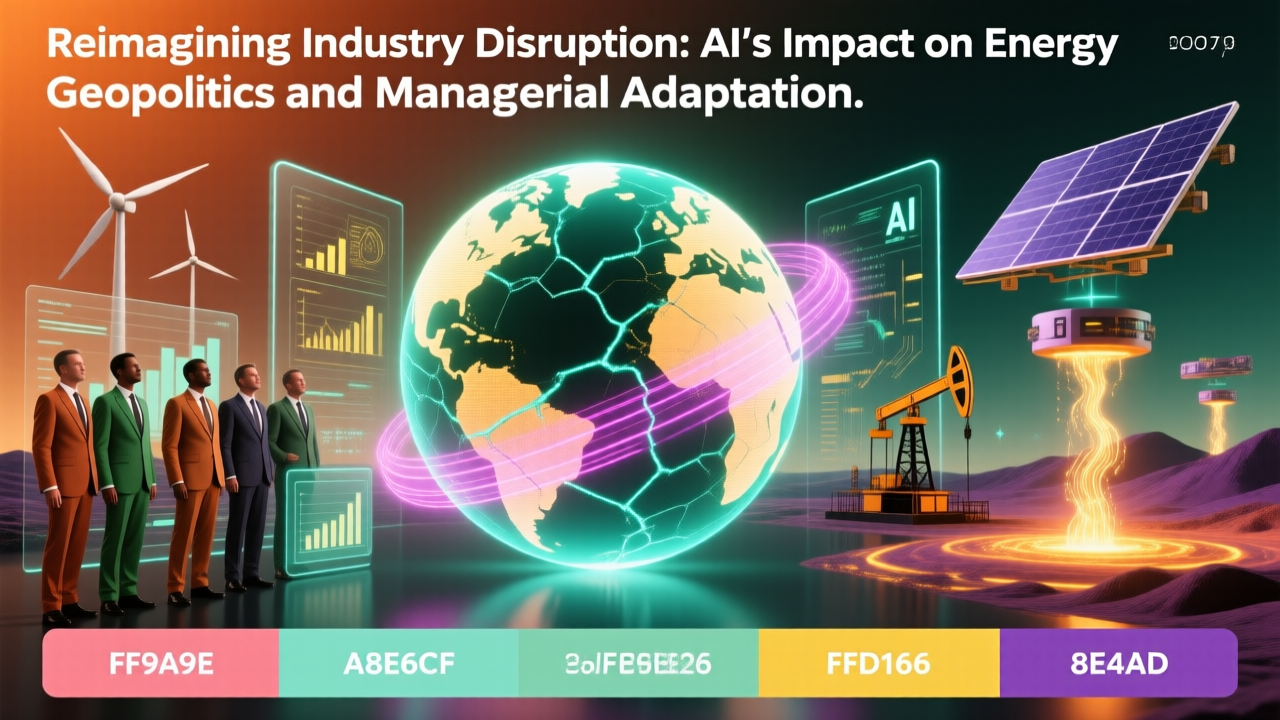

The Hormuz crisis wasn’t a wake-up call. It was a test of whether a manager could override the algorithm in time.
Introduction: Four Minutes in Rotterdam
At 04:13 GMT on 14 February 2026, the AI platform monitoring maritime transits for a Rotterdam-based energy trader lit up. Fourteen vessels in the Strait of Hormuz had gone dark simultaneously. AIS signals dead. Thermal satellite signatures erratic. The system, an ensemble of models that had predicted the 2024 Red Sea shipping disruptions with 89% accuracy, now calculated a 92% probability of a coordinated Iranian retaliation. Then it auto-generated a recommendation: execute a $90 million long position in Brent crude futures within the next four minutes. No human had yet seen the underlying intelligence. The shift manager, a 34-year-old engineer with two toddlers at home, stared at the screen. The model had never been wrong about an escalation before. But it had also never been tested on a situation where a false positive could bankrupt his desk.
This is not a story about the power of AI. It is a story about the moment of override. The human judgment that must sit between the prediction and the action. I’ve come to think of this as the Resilience Blind Spot. AI gives energy managers unprecedented foresight, but it also builds brittle systems that can shatter when the model’s assumptions break. Geopolitical assumptions. Technical assumptions. Ethical assumptions. For mid-level managers in the energy sector, surviving the 2026 order is not about trusting the algorithm. It is about knowing exactly when to ignore it.
This builds on a deeper pattern I explored earlier, the Predictability Paradox. AI grants astonishing foresight, but the real contest is the human willingness to override the algorithm when it matters most. If you haven’t read that piece, it sets the geopolitical stage that this article now applies directly to energy and management.
Executive Summary
- The Resilience Blind Spot: AI’s predictive power creates overconfidence. Managerial courage lies in questioning the machine.
- Energy Chokepoints Go Digital: The Strait of Hormuz crisis demonstrated that chokepoints are now informational as well as physical.
- Managerial Override Competency: Leaders need frameworks for deciding when to veto AI recommendations under deep uncertainty.
- Case Studies in Friction: The US-Israeli escalation and China’s biobank strategy reveal the cost of algorithmic deference.
- The 2026 Manager’s Toolkit: Scenario planning, red-teaming, and ethical circuit-breakers replace old crisis playbooks.
Energy Geopolitics in the Age of AI: The Resilience Blind Spot Unfolds
The Hormuz closure was a systemic test, but the deeper revelation was digital. As 20% of global oil tried to transit a 21-mile-wide strait, AI systems across the world were already rerouting tankers, recalibrating insurance premiums, and adjusting strategic petroleum reserve release schedules. The IEA’s emergency release, coordinated with AI-driven allocation models similar to those stress-tested during the 2022 Ukraine crisis, was praised as decisive. Yet the data driving it—predictive models of demand surges, real-time shipping route analytics, dynamic risk scoring—was only as good as the assumptions coded into it. As a post-incident IEA review later noted, one European reserve manager admitted: “The model told us to release at 10:00 GMT. We did. What it didn’t tell us was that a separate AI at a major refinery had already hedged against that release, squeezing margins. We were playing chess against our own machines.”
For managers, this creates a new imperative: override literacy. You do not need to build the AI. You do need to know its failure modes. Three questions every manager must ask during a crisis.
- What training data is this model using, and what does it exclude? The Hormuz models had no proxy for an Iranian commander’s emotional decision-making. They had never been taught the irrational.
- What is the model optimizing for, and what does it ignore? Cost minimization often overlooks crew welfare or long-term reputation. And those things matter when the world is watching.
- If we execute the AI’s recommendation, what second-order effects could cascade? The Rotterdam manager’s $90M trade could have triggered a margin call spiral. Nobody had modeled that.
The Multipolar Order and Managerial Scenario Planning
The erosion of the rules-based international system means managers face fluid alliances. The Arab-US alliance reassessment, underscored by Saudi Arabia’s 2023 China-brokered rapprochement with Iran and the UAE’s deepening technology partnerships with Beijing, forces energy firms to balance investments in both US-aligned shale technologies and China’s AI-driven solar supply chains. Traditional risk matrices fail here. I recommend a three-scenario framework instead.
- Scenario A (Continuity): Hormuz stabilizes. AI continues to optimize supply. Managers focus on incremental efficiency. Comfortable, but unlikely.
- Scenario B (Fragmentation): Regional blocs harden. AI systems are walled off. Managers must build parallel operational capabilities, one for each bloc. Expensive and messy.
- Scenario C (Systemic Shock): A cascading AI failure, perhaps a coordinated cyberattack on maritime AI, freezes global energy logistics for 72 hours. Managers need pre-authorized override protocols and human-only fallbacks. This is the nightmare scenario. Few firms have rehearsed it.
This is not forecasting. It is building organizational muscle memory for radically different futures. The companies that survive Scenario C will be those that ran the tabletop exercise on a quiet Tuesday, months before the missiles flew.
Case Study 1: The LNG Tanker That Talked Back
In the chaos following the US-Israeli strikes, an LNG tanker, Poseidon Star, was mid-Gulf. Its AI route optimizer screamed at the captain to head south toward the Arabian Sea. Fuel margins were tight, but adequate. The AI’s primary goal was fuel economy and scheduled arrival. The human captain noted something else. Social media channels were lighting up with unconfirmed reports of drone swarms near a chokepoint off Oman. The AI had no variable for “unconfirmed social media reports of drone swarms.” It was not trained on Twitter. The captain overrode the system, pushing east toward the Malacca Strait. The detour added 36 hours to the voyage. The cargo arrived without incident. The company’s post-crisis review found that the AI, optimized for fuel and speed, had been blind to soft intelligence. The captain’s decision saved an estimated $14 million in potential damages.
The lesson is not that humans are better than machines. It is that AI is a brilliant navigator but a poor intelligence analyst. Managers must fuse machine data with human context. That means building teams where a seasoned mariner’s gut feel can veto a neural network without a lengthy bureaucratic battle.
Case Study 2: The Biobank Warning for Energy Managers
China’s massive biobank initiative might seem distant from oil and gas, but it is a blueprint for how AI can leapfrog legacy industries. Chinese AI models, trained on vast genetic and health datasets, are accelerating materials science. They are designing new catalysts for green hydrogen production at a pace Western labs simply cannot match. This directly threatens energy firms: new catalysts discovered via AI-trained biobank data could slash green hydrogen costs by up to 40%, undercutting incumbent electrolyzer investments that were based on last decade’s assumptions. For a manager in a European energy firm, the competitive threat is not cheaper solar panels. It is an entirely new hydrogen production process that makes your $2 billion plant obsolete before the decade is out.
The managerial response starts with building a “tech horizon-scanning” cell. Partner with biotech startups. Learn to read AI-driven patent filings for early warning signals. The Resilience Blind Spot applies here too. Your current market position can blind you to the S-curve that an AI across the ocean is already climbing. You will not see it coming unless you deliberately look.
Visualizing the Core Idea: The Brittle vs. Resilient Path
The Resilience Blind Spot is easier to grasp when you see the fork in the road. The diagram below illustrates what’s at stake. On the left, a system that blindly follows AI optimization into a catastrophic failure. On the right, a system where a human override intervenes and redirects toward a resilient outcome.
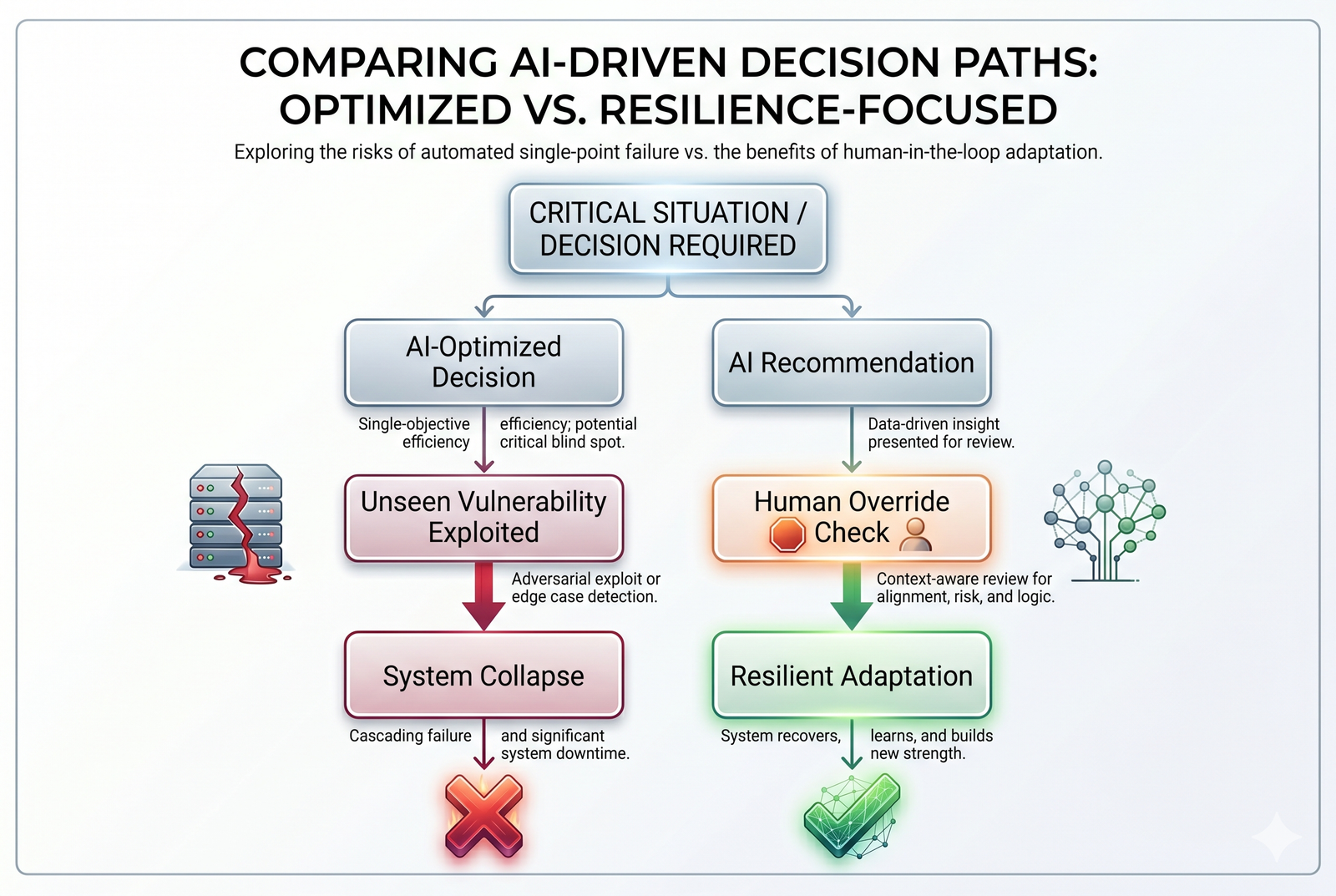
Figure: The Brittle vs. Resilient path. When managers override AI, systems bend but don’t break.
Reflection: The Override Imperative
The convergence of AI and energy geopolitics hands managers a strange burden. The tools that make you faster also make you fragile. Your role is not to become a data scientist. It is to become the institutional skeptic-in-chief. The person who asks, before every AI-generated decision, “What are we missing?” And who has the authority to say “No” without being punished for it.
In a multipolar world where algorithms can cascade failure across supply chains in seconds, the most valuable leadership trait is the courage to hit the override button, document the reasons, and absorb the risk. That courage cannot be automated. It can only be cultivated.
Visual Tables
Table 1: The Resilience Blind Spot – Where AI Helps vs. Where It Hurts
| AI Strength | Resilience Blind Spot | Managerial Override Tactic |
|---|---|---|
| Real-time supply disruption alerts | Model may ignore unconventional threats (e.g., social media rumors of drone swarms) | Establish a “soft signal” check before full reliance on automated alerts |
| Predictive maintenance cuts downtime | False sense of security leads to deferred manual inspections | Schedule random human audits of critical equipment regardless of AI “all clear” |
| Optimal route planning | Optimization for cost/speed blinds to crew fatigue, geopolitical nuance | Mandate a human-in-the-loop override for any route change exceeding 12-hour deviation |
| Dynamic reserve release algorithms | Models may not account for competitors’ AI actions, creating feedback loops | Pre-define breakpoints where release decisions revert to human committee review |
Table 2: Managerial Scenario Planning for AI-Driven Energy Crises
| Scenario | AI Posture | Managerial Priority | Key Override Trigger |
|---|---|---|---|
| Regional instability (e.g., Hormuz) | AI provides early reroute options, fuel hedging | Cross-functional rapid response team with override authority | Unconfirmed incident reports not yet in model’s dataset |
| Tech cold war (AI supply chain decoupling) | AI critical mineral sourcing models break due to sanctions | Dual-source critical software; manual alternative planning | AI recommendation conflicts with trade compliance flags |
| Systemic AI failure (coordinated cyberattack) | Fallback to pre-AI manual systems | Pre-authorize human-only decision protocols, maintain paper backups | Loss of data integrity for >15 minutes; automatic human take-over |
Frequently Asked Questions
How can AI help managers predict geopolitical risks in the energy sector?
Think of it like a car’s collision-avoidance system. AI scans for the equivalent of a sudden lane-change in global shipping data, sanctions lists, and social unrest indicators. It cannot prevent the crash. It can give you a three-second head start. In the 2026 Hormuz crisis, that head start was the difference between tankers stranded mid-voyage and those already rerouted before the first missile.
What steps should managers take to integrate AI into their operations responsibly?
Start by asking hard questions about the data the AI was trained on and the incentives baked into its optimization. Then build a small, empowered team with the authority to audit and challenge AI recommendations. That team needs air cover from senior leadership. Without it, override will never happen. Technical training matters, but cultural permission matters more.
How does the multipolar order affect managerial decision-making?
It forces you to consider multiple stakeholder worlds simultaneously. A decision that pleases one regional bloc may anger another. The old playbook of optimizing for a single global standard is dead. Managers must build teams that can operate with parallel assumptions, switching mental models on a Tuesday afternoon because an alliance shifted overnight.
Can AI mitigate the risks of energy supply disruptions?
It can dramatically improve preparedness and response time. But it cannot eliminate risk. The Resilience Blind Spot reminds us that over-reliance on AI creates new vulnerabilities, especially when models fail silently. The goal is not perfect prediction. It is resilient response, with or without the machine.
What role do managers play in shaping the future of AI in geopolitics?
Managers are the linchpin between the algorithm and the real world. They can demand transparency, build override mechanisms, and set the ethical tone. The AI may suggest. The manager decides. In a world racing toward autonomy, that human decision remains the most important geopolitical act.
As the world grapples with the dual forces of AI and energy geopolitics, the manager’s role has never been more critical. The future is not written in oil or code. It is shaped by those who dare to reimagine it. And by those who know when to say no.

 By
By
 By
By