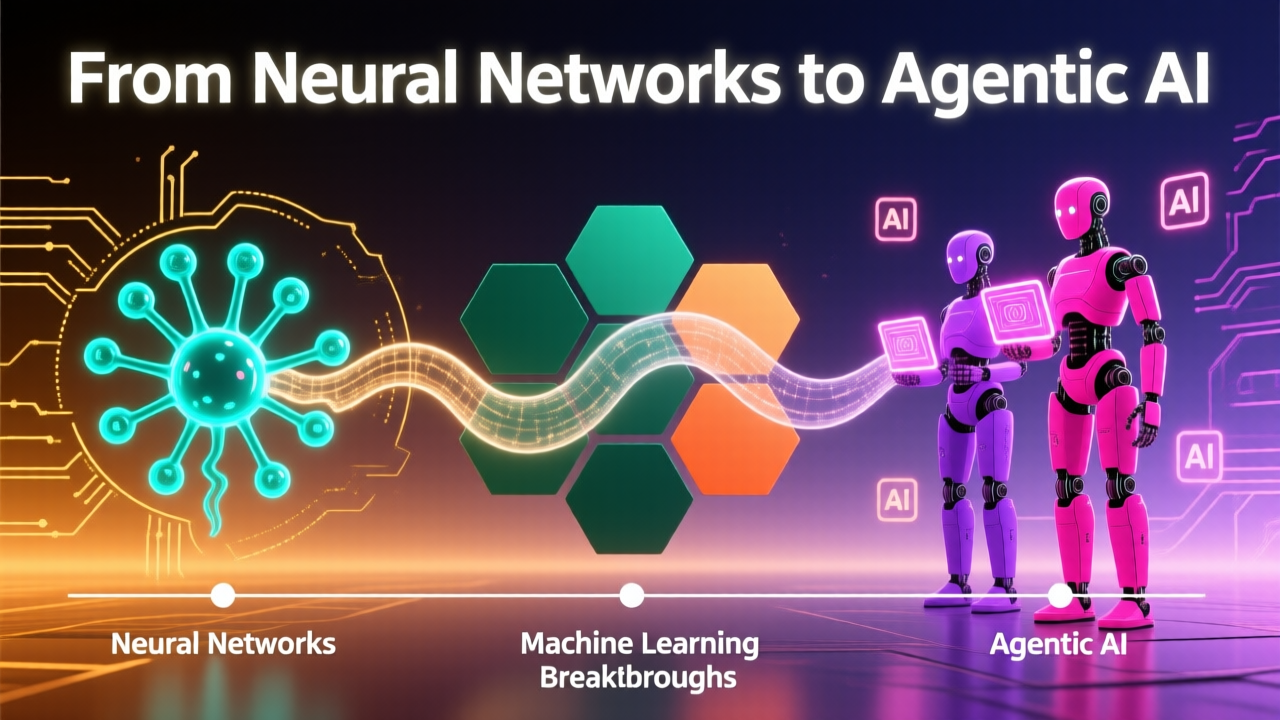

The dawn of artificial intelligence began with a simple question: can machines think? From the first neural network models to today’s agentic systems capable of autonomous decision-making, the evolution of AI has been a journey of exponential complexity. This article traces that journey, revealing how early computational theories laid the groundwork for modern agentic AI – and how students, researchers, and professionals can harness these advancements to reshape industries.
Executive Summary
- From isolated models to agentic systems: AI has evolved from monolithic models to compound systems integrating databases, external tools, and autonomous decision-making.
- Reinforcement learning and LLMs as catalysts: The agentic era (2010s–present) was driven by large language models (LLMs) and reinforcement learning, enabling general-purpose reasoning.
- Ethical frameworks: New governance models are essential to address risks in agentic AI, ensuring transparency and human oversight.
- Multi-agent collaboration: Frameworks like crewAI and AutoGen demonstrate the power of distributed problem-solving through agent networks.
- Historical continuity: Early concepts like cybernetics and neural networks directly influenced modern agentic architectures.
The Foundations: Neural Networks and Early AI
1943–1950: The Birth of Computational Thinking
The story begins in 1943, when Warren S. McCulloch and Walter Pitts published foundational work on neural networks, modeling the brain’s structure using mathematical logic. This laid the groundwork for artificial neural networks, which would later become the backbone of deep learning. By 1950, Alan Turing’s Computing Machinery and Intelligence introduced the Turing Test, a benchmark for machine intelligence that remains relevant today.
1955–1986: The Rise of AI as a Discipline
The term artificial intelligence was coined in 1955, marking the formalization of AI as a field. Early systems like MYCIN (an expert system for diagnosing bacterial infections) and Shakey (the first mobile robot combining AI, sensing, and logical reasoning) demonstrated the potential of rule-based systems. However, these models were limited by their inability to learn or adapt, relying instead on pre-programmed logic.
1986–1989: The Backpropagation Revolution
The 1980s saw a breakthrough with the development of the backpropagation algorithm by David Rumelhart, Geoffrey Hinton, and Ronald Williams in 1986. This algorithm enabled neural networks to adjust their weights based on error gradients, paving the way for modern deep learning. Yann LeCun’s application of backpropagation to image recognition in 1989 marked the first step toward convolutional neural networks (CNNs), which would later dominate computer vision.
The Agentic Era: From LLMs to Autonomous Systems
2010s–2020s: The Rise of Large Language Models
The 2010s ushered in a new era with the advent of large language models (LLMs) like GPT and BERT. These models, trained on vast datasets, demonstrated unprecedented language understanding and generation capabilities. However, their true potential was unlocked when combined with reinforcement learning from human feedback (RLHF), introduced in 2017, which aligned AI outputs with human preferences.
2022–2024: The Emergence of Agentic AI
By the early 2020s, LLMs began to evolve beyond content generation. Meta AI’s Toolformer (2023) demonstrated how LLMs could autonomously select and use external tools, a precursor to full agentic systems. This period also saw the introduction of the Model Context Protocol (MCP) and Agent Communication Protocol (ACP) in 2024, standardizing how agents interact with external systems and each other.
2025: Agentic AI as a Transformative Force
Today, agentic AI is the industry buzzword, with applications spanning healthcare, supply chains, and autonomous robotics. PR2 Robot (early 2010s), paired with ROS (Robot Operating System), became the standard for autonomous manipulation, while RT-1 (2023) demonstrated multimodal foundation models generalizing to new robotics tasks. These examples highlight how agentic systems are bridging the gap between theoretical AI and real-world impact.
Frameworks and Taxonomies: Building Blocks of Agentic AI
Agentic vs. Generative AI: A Key Distinction
While generative AI focuses on content creation, agentic AI emphasizes autonomous action and decision-making. This distinction is critical for students and professionals: agentic systems don’t just generate text – they plan, act, and adapt to their environment. Frameworks like ReAct (think, act, observe, repeat) formalize this behavior, enabling agents to execute complex tasks.
Multi-Agent Collaboration: The Power of Distributed Intelligence
Modern agentic systems often rely on multi-agent collaboration, where multiple agents work together to solve problems. crewAI and AutoGen are frameworks that enable this, allowing agents to divide tasks, share knowledge, and optimize outcomes. For example, MetaGPT automates product requirements documentation (PRD) by distributing tasks across specialized agents.
Ethical and Governance Frameworks
As agentic AI becomes more autonomous, ethical considerations grow. Frameworks like Human-in-the-loop ensure human oversight, while Corrective RAG (Retrieval-Augmented Generation) refines outputs using feedback loops. Students and professionals must prioritize these frameworks to mitigate risks like bias, security vulnerabilities, and unintended consequences.
Case Studies: Lessons from the Field
1. PR2 Robot: The Standard for Autonomous Manipulation
The PR2 Robot, developed in the early 2010s, was a milestone in autonomous systems. Paired with ROS, it could navigate, manipulate objects, and execute multi-step tasks. This case study illustrates the importance of integrating perception, planning, and action in agentic systems – a principle students can apply to robotics, logistics, and automation projects.
2. Toolformer: LLMs as Autonomous Agents
Meta AI’s Toolformer (2023) demonstrated how LLMs could autonomously select and use external tools, such as calculators or databases. This marked a shift from passive language models to active agents capable of interacting with the environment. For students, this highlights the potential of combining LLMs with APIs and toolkits to build intelligent applications.
Reflection: The Future of Agentic AI
The evolution from neural networks to agentic AI is not just a technical progression – it’s a philosophical shift. Early AI sought to mimic human cognition, while agentic AI aims to replicate human agency. This raises profound questions: How do we ensure these systems align with human values? How do we balance autonomy with accountability?
For students and professionals, the challenge lies in mastering the frameworks, ethics, and applications of agentic AI. Whether designing autonomous robots, optimizing supply chains, or building multi-agent systems, the principles outlined in this article provide a roadmap for navigating this transformative era.
Frequently Asked Questions
What is the difference between agentic AI and generative AI?
Agentic AI focuses on autonomous decision-making and action, while generative AI emphasizes content creation. Agentic systems can plan, act, and adapt to their environment, whereas generative models primarily generate text, images, or other media.
How do multi-agent systems work?
Multi-agent systems involve multiple agents collaborating to solve complex tasks. Frameworks like AutoGen and crewAI enable agents to divide tasks, share knowledge, and optimize outcomes through distributed problem-solving.
What ethical considerations are important for agentic AI?
Ethical frameworks like Human-in-the-loop and Corrective RAG ensure transparency, accountability, and alignment with human values. Students and professionals must prioritize these to mitigate risks like bias, security vulnerabilities, and unintended consequences.
Can agentic AI replace human workers?
Agentic AI is designed to augment, not replace, human capabilities. While it can automate repetitive tasks, it still requires human oversight for complex decisions. The goal is to create systems that enhance productivity and creativity, not eliminate human roles.
What are the key frameworks for building agentic systems?
Key frameworks include ReAct (think, act, observe, repeat), Model Context Protocol (MCP), and Agent Communication Protocol (ACP). These provide standardized methods for integrating models with external systems and enabling agent-to-agent communication.
As agentic AI continues to evolve, its impact on industries, education, and society will only grow. By understanding its foundations, frameworks, and ethical implications, students and professionals can position themselves at the forefront of this transformative field.


 By
By
 By
By