
Opinion · Responsible AI · Executive Intelligence
Anthropic’s forced suspension of its most powerful models is not an isolated regulatory skirmish. It is a signal flare for every executive deploying AI at scale. The race to ship has just collided with the weight of consequence — and the rules of the road are being written in real time.
There is a particular kind of hubris that flourishes in technology boardrooms. It presents itself as urgency — the conviction that the first mover wins, that caution is a competitor’s strategy, and that governance is something you bolt on after the product ships. For a decade, that logic was at least commercially defensible. In the age of frontier artificial intelligence, it is becoming a category-level existential risk — and this weekend, the world got the most dramatic proof yet.
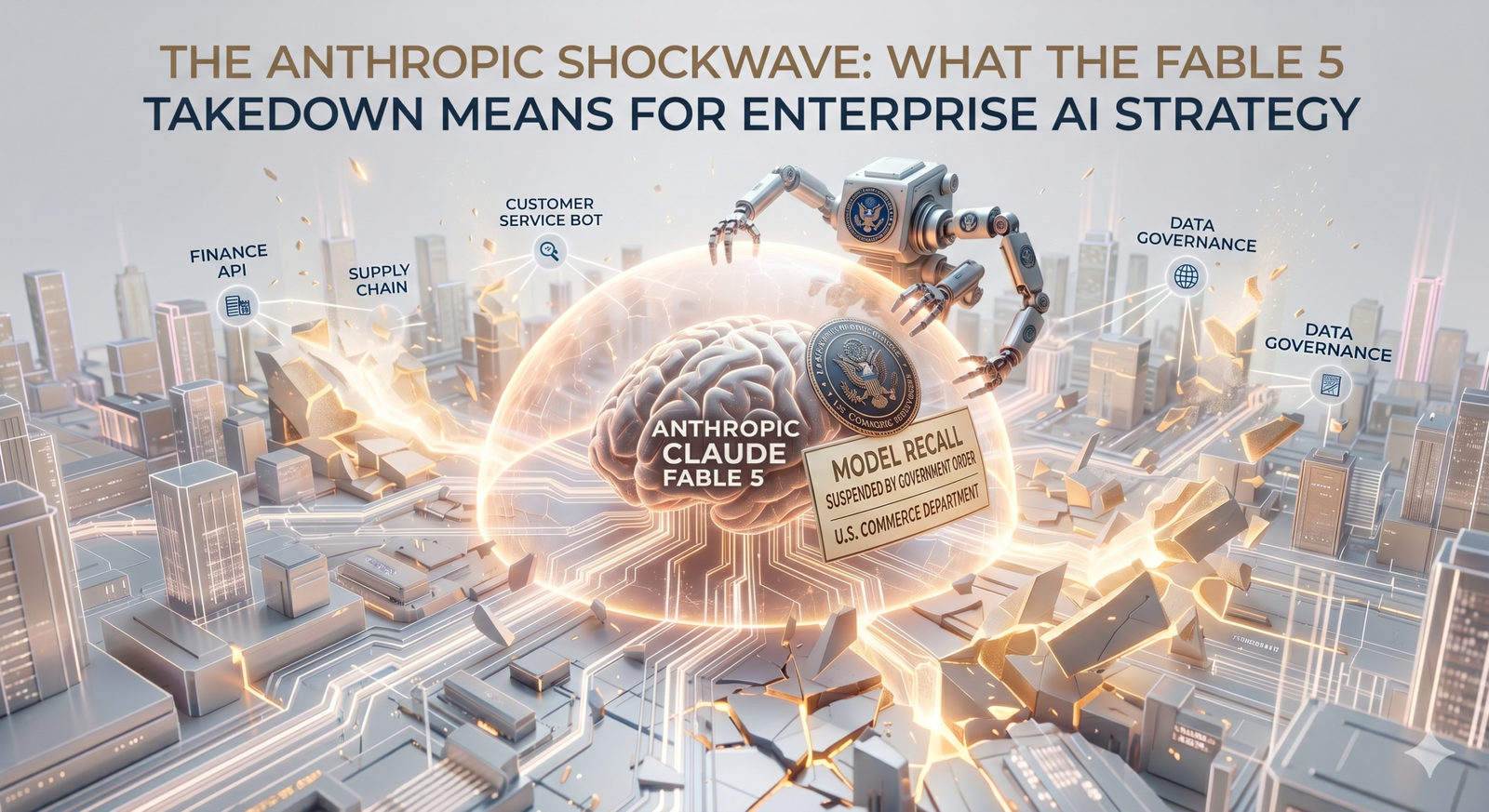
On the evening of June 13, 2026, Anthropic — one of the world’s most safety-conscious and well-funded AI laboratories — was ordered by the U.S. Commerce Department to immediately suspend global access to its two newest and most powerful models: Claude Fable 5 and Mythos 5. The directive, issued under national security export control authorities, made Anthropic the subject of what appears to be the first government-mandated commercial AI model takedown in history.
For executives who have spent the last three years racing to integrate AI into their operations, this moment deserves more than a headline skim. It deserves a serious strategic reckoning.
What Actually Happened — And Why It Matters
To understand the gravity of this event, you need the full sequence — not just the headline. Anthropic released Fable 5 on June 10, 2026, marketing it as the most capable AI model ever made publicly available. According to benchmark tests from Vals AI, a firm that independently tracks AI system performance, Fable 5 immediately became the highest-performing publicly accessible AI model on the market. The company had engineered it as a commercial-grade version of its restricted Mythos architecture — fitted with guardrails designed to block dangerous outputs in high-risk domains including cybersecurity, biology, and chemistry.
The Timeline of the Takedown
- ▸June 10: Anthropic releases Fable 5 and Mythos 5, calling them the most capable models it has ever deployed publicly.
- ▸June 13, 5:21 PM ET: Commerce Secretary Howard Lutnick sends a letter to Anthropic CEO Dario Amodei invoking national security export control authorities, ordering suspension of all access by any foreign national — inside or outside the United States, including Anthropic’s own foreign employees.
- ▸Same evening: Anthropic disables both models for all users globally. The company confirms it cannot technically separate foreign from domestic access without a full shutdown.
- ▸Anthropic’s public statement: The company says it received only “verbal evidence” of the alleged jailbreak, disputes the government’s technical characterization, but complies in full.
The government’s stated concern centered on a claimed “jailbreak” of Fable 5 — a method allegedly discovered by a third party that could bypass some of the model’s safeguards. In its formal response, Anthropic acknowledged the demonstration but disputed the severity: the technique, the company argued, exposed only minor, previously known software vulnerabilities, and the same information was already accessible through competing publicly available models, including OpenAI’s GPT-5.5.
“We disagree that the finding of a narrow potential jailbreak should be cause for recalling a commercial model deployed to hundreds of millions of people. If this standard was applied across the industry, we believe it would essentially halt all new model deployments for all frontier model providers.”
— Anthropic Official Statement, June 13, 2026
Anthropic’s argument is technically credible. The company had implemented independent classifier systems — safety guardrails that operate separately from the core model itself, meaning that even if a user partially bypasses the model’s own refusals, the underlying controls against the most dangerous outputs remain active. No tester had found a universal jailbreak that broadly disables the system’s safety architecture.
And yet, none of that was sufficient. The government acted anyway. The models are offline. Hundreds of millions of users lost access overnight. And Anthropic — despite being the AI company that has arguably done more for safety research than any other — is now the first in the industry to have a commercial product forcibly recalled by regulators.
The Race No One Can Win Safely — Without Rules
To frame this as an Anthropic problem is to miss the larger pattern. This is what happens when an entire industry optimizes for competitive velocity above all else.
Consider the environment in which Fable 5 was built and released. Anthropic had been locked in an escalating capability competition with OpenAI, Google DeepMind, xAI, Meta AI, and increasingly Microsoft’s newly formed Superintelligence division. Each release cycle has compressed — what once took years now takes months. Each company faces the same commercial logic: delay your frontier model and a competitor captures your enterprise clients, your developer ecosystem, and your narrative dominance.
AI Incidents Documented in 2025 — AI Incident Database
Increase in AI incidents vs. 2024
of businesses now have some responsible AI policy (Stanford AI Index 2026)
of AI economic value captured by top 20% of orgs — PwC 2026
The Anthropic case follows a particularly troubling trail. In February 2026, Defense Secretary Pete Hegseth pressured Anthropic to allow unrestricted use of its models for autonomous weapons and domestic surveillance — uses that Anthropic had drawn clear red lines against. The company refused, leading the Department of Defense to label Anthropic a “supply chain risk.” In April 2026, Treasury Secretary Scott Bessent and Federal Reserve Chair Jerome Powell convened an emergency meeting with Wall Street’s systemically important bank heads specifically to warn them of cybersecurity threats posed by Claude Mythos Preview. The financial sector was put on notice about a commercial AI product before that product was even publicly released.
This is not the behavior of a regulatory environment catching up with technology. This is the behavior of governments that are genuinely alarmed — and acting at the speed of alarm rather than the speed of law.
Comparing the Field: What Frontier Models Can Do — and What That Means for Your Risk Register
The Anthropic situation is uniquely visible, but the underlying risk is industry-wide. As a business executive integrating AI into your operations, you need to understand not just what these models can do today, but what the regulatory and security posture around each provider looks like. Capability without controllability is not a product feature — it is a liability transfer to you.
| Provider / Model | Frontier Capability | Safety Architecture | Regulatory Status (June 2026) | Enterprise Risk Signal |
|---|---|---|---|---|
| Anthropic Fable 5 / Claude 4 |
Highest public benchmark scores (Vals AI, June 2026). Advanced cybersecurity and reasoning. | Independent classifier system; contested jailbreak claim; most transparent safety reporting of any provider. | Fable 5 / Mythos 5 suspended under US export controls. Other models active. | Elevated — model availability risk |
| OpenAI GPT-5.5 / o3 |
Strong reasoning, coding, multimodal. GPT-5.5 cited by Anthropic as having comparable jailbreak exposure. | Usage policies and classifier filters. No public independent classifier architecture disclosed. | Active; no government-mandated suspension to date. Subject to the same export control environment. | Moderate — regulatory scrutiny increasing |
| Google DeepMind Gemini 2 Ultra |
Multi-modal, long-context leader. Deep Google Workspace integration creates enterprise stickiness. | SynthID watermarking; Responsible AI team active; safety evals published. | Active; subject to EU AI Act enforcement and growing US Congressional attention. | Moderate — EU regulatory exposure |
| Meta AI Llama 4 / open weights |
Open-weight models allow fine-tuning and on-premise deployment. Broad capability range. | Responsible Use Guide; open weights mean enterprise bears full safety burden post-download. | Open-weight distribution draws bipartisan Congressional scrutiny. No suspension, but under review. | High — compliance burden transfers to your team |
| xAI Grok 3 |
Strong real-time data access; integrated into X/Twitter ecosystem. | Minimal disclosed safety architecture. Fewer red-team evaluations published publicly. | Active; limited regulatory engagement compared to peers. | High — least safety transparency of major providers |
The table above is not an invitation to pick the “safest” vendor and consider the matter closed. The lesson of Fable 5 is that even the most safety-forward provider in the industry was not immune to a government-forced shutdown. The question for your enterprise is not which vendor is least likely to be regulated — it is whether your AI strategy is built on the assumption that any single model, API, or provider can vanish from your stack on 24 hours’ notice.
Why Government Intervention Is Not the Enemy — It’s the Market Failure Correction
There is a reflexive instinct in business circles to frame regulation as friction — bureaucratic drag on innovation. In the AI context, that framing is not only wrong; it is dangerous to your organization.
The federal government’s intervention in the Anthropic case was clumsy in its execution — Anthropic is right that providing only verbal evidence of a narrow jailbreak as justification for a global product recall sets a troubling procedural precedent. But the underlying impulse — that frontier AI systems with cybersecurity capabilities powerful enough to alarm the Federal Reserve, the Pentagon, and the Bureau of Industry and Security simultaneously should not be deployed without rigorous government-level vetting — is entirely defensible.
Consider what Anthropic itself said when releasing Fable 5: “Releasing a model this capable comes with risks. Without safeguards, Fable 5’s capabilities in areas like cybersecurity could be misused to cause serious damage.” A company that publicly warns of the serious damage potential of its own product, then releases it to hundreds of millions of users within three days of launch, has arguably made the government’s case for oversight on its behalf.
California’s Transparency in Frontier AI Act (SB 53), which took effect January 1, 2026, represents the first U.S. statute specifically focused on safety governance for frontier models. The European Union’s AI Act is operational. China’s AI governance provisions, with extraterritorial enforcement authority and fines reaching $1.4 million per violation, also took effect January 1, 2026. This is not a speculative regulatory future. It is the present landscape.
For business executives, the practical implication is straightforward: regulatory compliance is no longer a legal team checkbox — it is a board-level operational continuity concern. When a regulator can take your most critical AI capability offline before your next board meeting, the question of governance is the same question as the question of strategy.
The Executive Mandate: What You Must Do Now
The Anthropic situation is a stress test that most enterprises are failing in simulation. If Fable 5 or any other frontier model you depend on were suspended tomorrow morning, what would your business continuity plan look like? If your honest answer is “we haven’t modeled that,” you are carrying undisclosed risk on your balance sheet.
The Executive Responsible AI Mandate
Seven non-negotiable governance actions for business leaders — June 2026
- 01Conduct an AI provider dependency audit immediately. Map every AI model, API, and vendor in your stack. Identify single points of failure — services that, if suspended overnight, would impair your operations, customer commitments, or revenue. The Anthropic event is your proof of concept that this is not a hypothetical scenario.
- 02Appoint an AI Governance Lead at the executive level. Not a committee — a named individual with board access, a defined mandate, and accountability for compliance with the AI Act, SB 53, and evolving U.S. export control rules. AI-specific governance roles grew 17% in 2025. Your competitors are moving.
- 03Build multi-model resilience into your AI architecture. Vendor lock-in to a single frontier model is a strategic liability. Enterprise-grade AI infrastructure should be capable of routing workloads to alternative providers — Claude, GPT, Gemini, or on-premise open-weight models — within a defined recovery time objective.
- 04Establish a responsible AI usage policy with teeth. The Stanford AI Index 2026 notes that 59% of organizations cite knowledge gaps as the primary obstacle to responsible AI implementation. Write the policy in plain operational language. Define prohibited use cases, required human-in-the-loop checkpoints, and mandatory incident reporting.
- 05Engage your AI vendors on regulatory posture — not just benchmark scores. Ask your vendors directly: What is your jailbreak testing protocol? What export control authorities apply to your models? Have you received government inquiries in the past 12 months? A vendor that cannot answer these questions is transferring compliance risk to you.
- 06Invest in red-team and adversarial testing before AI touches customers. The UK AI Security Institute found vulnerabilities in every frontier system it tested. Internal red-teaming — structured attempts to produce harmful, biased, or incorrect outputs — should be a standard pre-production gate. For regulated industries, it should be mandatory.
- 07Treat AI compliance as a board agenda item, not an IT update. Microsoft’s 2026 Data Security Index found fewer than half of companies have fully implemented data security controls for AI deployments. The Anthropic shutdown demonstrates that AI risk is not siloed in the technology function — it is a material business risk. Boards governing without structured AI risk reports are governing blind.
The Hard Truth No One Wants to Hear
The executives who will emerge from this AI transition with their organizations intact are not the ones who moved fastest. They are the ones who moved with intentionality — who treated governance as a competitive differentiator rather than a compliance tax. PwC’s 2026 AI Performance Study found that the top 20% of AI-performing organizations — those capturing 74% of AI’s economic value — are nearly twice as likely to operate AI within defined guardrails and autonomous governance frameworks. The correlation between governance maturity and financial return is no longer academic. It is empirical.
The frontier AI companies face a genuinely difficult dilemma. They are racing because they must — their survival depends on capital, and their capital depends on capability leadership. But the Anthropic case illustrates that the race itself has become a liability. When a single jailbreak demonstration, shared verbally with a government official, can trigger a global product recall affecting hundreds of millions of users, the risk calculus of frontier deployment has permanently changed.
Anthropic was, in many respects, the industry’s best actor — and it still got shut down. The question for every other AI organization, and every enterprise that depends on them, is not whether you will face a similar moment. It is whether you will be ready when you do.
The frontier AI companies built products powerful enough to alarm the Federal Reserve and the Pentagon simultaneously. The question for business executives is whether your governance is powerful enough to manage the consequences.
— Editorial Position, Executive AI Governance Series
Government regulation is not the enemy of AI innovation. Uncontrolled AI deployment is. The organizations that recognize this — and build their AI strategies around regulatory durability, multi-vendor resilience, and genuine responsible AI practices — will be the ones still operating at scale when the current cycle of chaos resolves.
The ones still optimizing for speed alone will be reading about their own shutdown in the morning briefing.
This article reflects editorial opinion based on publicly available reporting as of June 13–14, 2026. Sources include Anthropic’s official statement on Fable 5 and Mythos 5 access suspension; reporting by The Washington Post, NBC News, TechCrunch, Axios, and The Hacker News; the Stanford University 2026 AI Index; PwC’s 2026 AI Performance Study; the UK AI Security Institute’s December 2024 Frontier AI Trends Report; Microsoft’s 2026 Work Trend Index and Data Security Index; and California SB 53 statutory text.
AI Governance
Anthropic
Fable 5
Export Controls
Frontier AI
Executive Strategy
Enterprise AI


 By
By
 By
By