

Embodied Intelligence: The Rise of Physical AI
Executive Summary
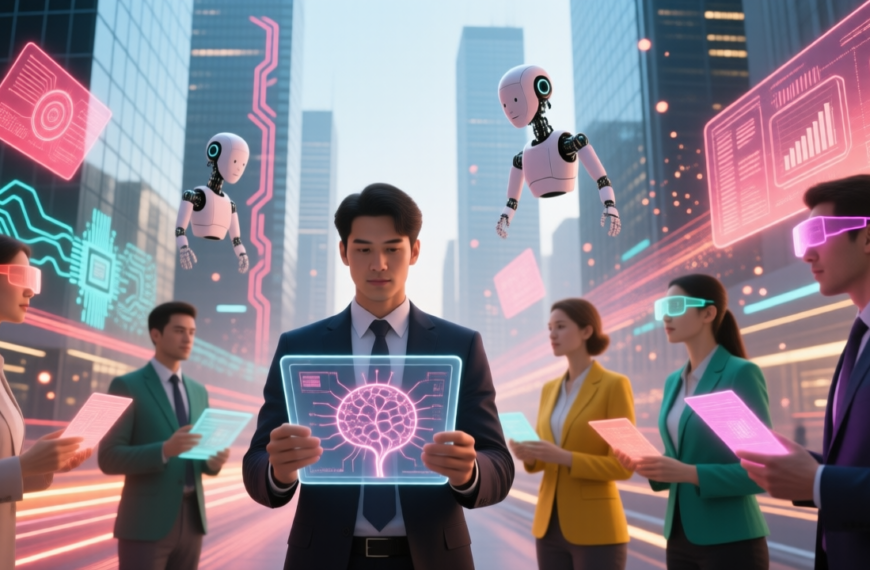
As we navigate the technological landscape of 2026, the paradigm of artificial intelligence has fundamentally shifted from the purely digital realm to the physical world. Embodied Intelligence, or Physical AI, represents the convergence of advanced machine learning models with sophisticated robotics, creating systems that can perceive, reason, and act within unstructured physical environments. This descriptive analysis explores the rapid ascent of physical AI, detailing the core technologies driving this revolution, its profound impact across various industries, and the emerging frameworks governing its deployment.
“The transition from screen-bound AI to embodied intelligence is not merely an upgrade; it is the genesis of a new operational reality where machines understand the physics of our world.” — Dr. Elena Rostova, Institute for Advanced Robotics, 2026.
We will examine the critical milestones achieved in spatial computing, sensor fusion, and actuator design that have made this possible, alongside real-world case studies demonstrating the tangible benefits of deploying physical AI in manufacturing, healthcare, and logistics. This report provides a comprehensive overview of the current state and future trajectory of embodied intelligence.
1. The Anatomy of Physical AI: Bridging the Digital-Physical Divide
The concept of embodied intelligence is rooted in the idea that true intelligence requires interaction with the physical world. Unlike traditional AI, which operates on abstract data sets, physical AI systems are grounded in reality through sensors and actuators. In 2026, the architecture of these systems has reached unprecedented levels of sophistication.
Sensory Perception and Spatial Computing
Modern physical AI relies on a multi-modal sensory approach, often referred to as Sensor Fusion 2.0. This involves the real-time integration of data from high-resolution LiDAR, stereoscopic cameras, tactile sensors, and acoustic arrays. By combining these inputs, the AI constructs a dynamic, high-fidelity 3D model of its surroundings, allowing it to navigate complex, unpredictable environments with millimeter precision.
- Advanced Tactile Sensing: The development of neuromorphic synthetic skin has enabled robots to perceive texture, temperature, and pressure, allowing for delicate manipulation of fragile objects.
- Real-time Spatial Mapping: Utilizing advanced SLAM (Simultaneous Localization and Mapping) algorithms, physical AI agents can map unknown environments instantly, adapting to changes such as moving obstacles or altered terrain.
- Acoustic Spatial Awareness: Beyond visual data, systems now use sound to gauge the density of objects, detect unseen machinery faults, and even interpret human emotional states through voice analysis.
2. The Cognitive Engine: Large Physical Models (LPMs)
The cognitive leap in physical AI is driven by the evolution of Large Language Models (LLMs) into Large Physical Models (LPMs). These models are trained not just on text and images, but on vast datasets of physical interactions, kinematic simulations, and real-world physics engines.
| Model Characteristic | Traditional LLMs (Pre-2024) | Large Physical Models (2026) |
|---|---|---|
| Training Data | Text, Code, Static Images | Video, Kinematics, Tactile Data, Physics Simulations |
| Output Modality | Text, 2D Media | Physical Action, Torque Commands, Spatial Navigation |
| Environment | Digital / Virtual | Physical / Unstructured Real World |
| Reasoning Type | Linguistic, Logical | Spatial, Kinematic, Temporal |
LPMs allow robots to understand cause and effect in the physical world. If an embodied AI drops a glass, it understands the physics of the shatter, the sound it makes, and the necessary steps to clean it up safely, without needing explicit, step-by-step programming for that specific event.
3. Industry Impact and Real-World Applications
The deployment of embodied intelligence is reshaping the operational foundations of numerous sectors. By automating complex physical tasks, organizations are achieving unprecedented levels of efficiency and safety.
Manufacturing: The Hyper-Flexible Factory
In the manufacturing sector, physical AI has catalyzed the shift from rigid assembly lines to hyper-flexible micro-factories. Embodied agents, equipped with LPMs, can be re-tasked on the fly simply through natural language commands. For example, a robotic arm previously assembling automotive components can be instructed to perform quality assurance checks on a different product line within minutes, adapting its grip and visual inspection parameters autonomously.
Healthcare: Assisting the Frontlines
The healthcare industry has seen a rapid integration of physical AI, particularly in eldercare and surgical assistance. Embodied systems are now capable of safely lifting and transferring patients, significantly reducing the physical strain on nursing staff. In surgical settings, AI-driven robotic assistants provide micro-millimeter precision, compensating for human tremors and utilizing real-time tissue analysis to guide the surgeon’s hand.
Logistics: The Autonomous Supply Chain
Logistics and warehousing have been completely transformed. Fleets of embodied AI agents navigate massive distribution centers, seamlessly collaborating with human workers and other machines. These systems optimize storage density, predict inventory bottlenecks, and execute complex picking and packing operations that require handling a vast array of differently shaped and weighted items.
4. The Framework for Embodied Action: Safety and Ethics
As physical AI systems become more autonomous and capable, the need for robust safety frameworks and ethical guidelines has become paramount. The industry has coalesced around several key principles to ensure the responsible deployment of these technologies.
The Physical Alignment Problem
Aligning the goals of an embodied AI with human values is significantly more complex than aligning a text-based model. A physical action has immediate, tangible consequences. The Physical Alignment Framework of 2026 dictates that all embodied systems must possess verifiable “fail-safe” mechanisms and operate within strict, mathematically proven kinematic boundaries.
- Kinematic Constraints: Hard-coded limits on speed, force, and range of motion that the AI cannot override, ensuring physical safety in proximity to humans.
- Interpretability of Action: The system must be able to explain the reasoning behind its physical actions in real-time, allowing human operators to understand and anticipate its behavior.
- Graceful Degradation: In the event of sensor failure or cognitive uncertainty, the system must default to a safe, stationary state rather than attempting to execute an unpredictable action.
5. Case Study: Project Atlas-Prime in Urban Search and Rescue
One of the most compelling demonstrations of embodied intelligence in 2026 is Project Atlas-Prime, a collaborative initiative between the Global Rescue Consortium and leading AI research labs. Atlas-Prime is a humanoid physical AI designed for urban search and rescue operations in disaster zones.
During the recent seismic event in Neo-Kyoto, a fleet of Atlas-Prime units was deployed into structurally compromised buildings. Utilizing their advanced sensor fusion, they navigated debris-filled corridors, identified human survivors using thermal and acoustic signatures, and executed delicate extraction maneuvers.
“The Atlas-Prime units demonstrated an intuitive understanding of structural integrity that surpassed our human engineers on the ground. They didn’t just follow a map; they read the building.” — Commander Sato, Global Rescue Consortium.
This case study highlights the life-saving potential of physical AI when deployed in environments too hazardous for human responders.
6. The Hardware Bottleneck: Energy and Materials
While the cognitive capabilities of physical AI have advanced exponentially, the hardware required to support these systems remains a significant bottleneck. The energy demands of continuous spatial computing and complex actuation are immense.
Advances in Energy Density
The push for untethered, long-endurance embodied AI has driven innovation in battery technology. The commercialization of solid-state structural batteries in 2025 has allowed robots to store energy within their own chassis, significantly reducing weight and extending operational time. However, achieving human-level endurance remains a critical challenge.
Biomimetic Materials
To improve efficiency and agility, engineers are increasingly turning to biomimicry. The development of artificial muscles—electroactive polymers that contract and expand like biological tissue—promises to replace bulky, power-hungry electric motors. These materials offer higher power-to-weight ratios and smoother, more natural movements, essential for safe human-robot interaction.
7. The Role of Edge Computing in Physical AI
A critical enabler of Embodied Intelligence in 2026 is the maturation of Edge Computing. Physical AI systems cannot rely solely on cloud-based processing due to the latency involved in transmitting high-bandwidth sensory data back and forth. In dynamic, real-world environments, a delay of even a few milliseconds can result in a catastrophic failure or collision.
Decentralized Cognitive Processing
To overcome this, modern embodied agents are equipped with powerful onboard neural processing units (NPUs). These localized chips handle the immediate, reflex-like decisions required for balance, spatial navigation, and object manipulation. The cloud is reserved for higher-order strategic planning, long-term memory storage, and the periodic updating of the Large Physical Models.
Swarm Intelligence and Local Networks
Furthermore, Edge Computing enables robust Swarm Intelligence. In settings like automated warehouses or agricultural fields, fleets of physical AI agents communicate directly with one another over localized, high-speed mesh networks. They share spatial mapping data and coordinate complex, multi-agent tasks without needing a central, cloud-based dispatcher. This decentralized approach drastically improves system resilience; if one agent loses connection or malfunctions, the swarm dynamically reallocates tasks to ensure continuous operation.
8. The Future of Embodied Intelligence: Towards Symbiosis
Looking beyond 2026, the trajectory of physical AI points towards a deeper symbiosis between humans and machines. The focus is shifting from machines that operate independently to machines that augment human physical capabilities.
Exoskeletons and Physical Augmentation
The principles of embodied intelligence are being applied to advanced exoskeletons. These systems use predictive AI to anticipate the user’s movements, providing seamless physical support and amplifying strength and endurance. This technology is not only revolutionizing heavy industry but also offering profound mobility solutions for individuals with physical disabilities.
The Emergence of the “Robo-Sapien” Economy
As physical AI becomes ubiquitous, we are witnessing the dawn of the “Robo-Sapien” economy, where human creativity and strategic thinking are paired with the tireless physical execution of embodied agents. This economic model promises unprecedented productivity but also necessitates a radical rethinking of labor markets, education, and social safety nets.
Conclusion: The Physical Awakening
The rise of Embodied Intelligence marks a pivotal moment in human history. We have successfully breathed digital life into physical forms, creating entities capable of perceiving, understanding, and manipulating the world around them. As we continue to refine the cognitive models and hardware that power these systems, the boundary between the digital and physical realms will increasingly blur.
The challenges of energy density, safety, and societal integration are significant, but the potential benefits—from revitalizing manufacturing to saving lives in disaster zones—are too vast to ignore. The physical awakening of AI is not a distant future; it is the defining technological reality of 2026, demanding our attention, our ingenuity, and our responsible stewardship.
References and Industry Insights (2026)
- Global Robotics Observatory. (2026). The State of Large Physical Models and Sensor Fusion. Tokyo, Japan.
- Institute for Advanced Robotics. (2026). Kinematic Constraints and the Physical Alignment Problem. Boston, MA.
- Journal of Autonomous Systems. (2026). Solid-State Energy Solutions for Untethered Embodied Agents. Berlin, Germany.
- World Economic Forum. (2026). The Robo-Sapien Economy: Navigating the Physical AI Transition. Geneva, Switzerland.


 By
By



 By
By